
https://nufutene5.gumroad.com/l/evyxzn
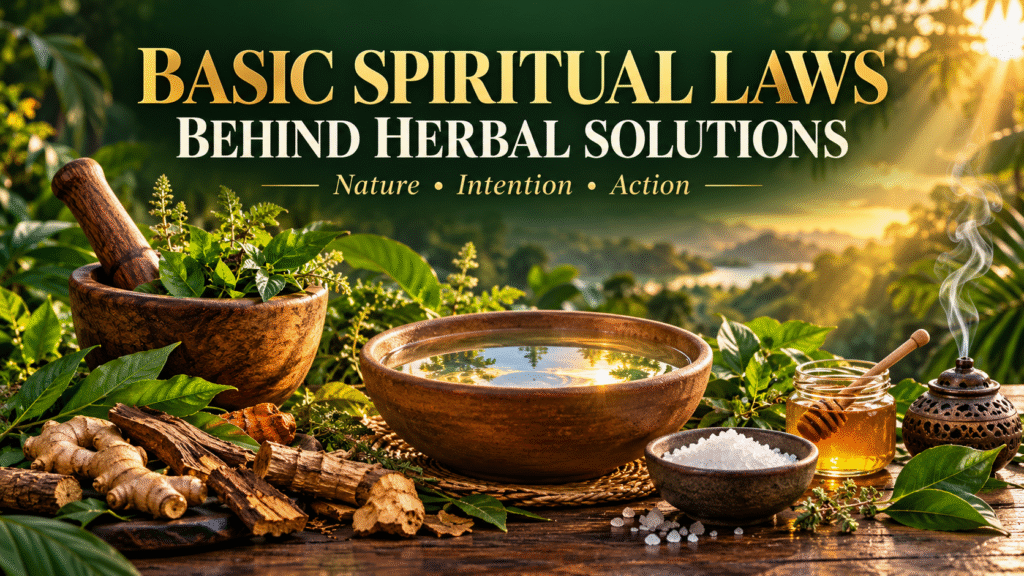
How intention, natural elements and everyday discipline come together in spiritual herbal practice.
A leaf in a bowl may look ordinary. Yet to a person who approaches it with reverence, it can represent cleansing, courage, remembrance or a fresh beginning. Water can mark a decision to release yesterday’s burdens. Honey can remind us to bring kindness into a troubled relationship. A spoken intention can give direction to a scattered mind.
This is the heart of spiritual herbal practice: working with nature while taking responsibility for the life you want to build.
The seven principles below develop a spiritual framework for understanding herbs and natural elements. They are teachings and interpretations, rather than scientifically established laws. African traditions are diverse; Akan, Ewe, Ga, Yoruba, Igbo and Vodun communities should never be treated as having one identical system.
Respect for nature becomes meaningful when it is joined by knowledge, safe practice and honest action.

1. Herbs Carry Spiritual Intelligence: Learn Their Character
Within the spiritual understanding presented here, a plant is approached as a living presence with its own character. Its scent, colour, texture and taste become part of the language through which a practitioner interprets it.
In this framework:
- Bitter herbs represent cleansing, release and confronting difficult truths.
- Sweet or pleasantly scented herbs represent welcome, harmony and attraction.
- Sharp or pungent herbs represent separation, boundaries and decisive action.
- Cooling herbs represent calm, patience and restoration.
- Warming herbs represent courage, movement and renewed effort.
These associations are spiritual interpretations. They do not establish what a plant can safely do inside the body. Bitterness does not prove that a herb removes toxins, and a warming sensation does not mean it is suitable for everyone.
Before choosing a plant, ask: What is it? Why am I choosing it? How will I use it safely?
Confirm the botanical identity. Local names can refer to different species, and a plant safe as food may require different precautions as a concentrated preparation.
The first discipline of herbal work is knowing what is in your hands.
2. Water Carries Prayer: Give Your Intention Direction
In the framework described here, water becomes a focus for prayer, blessing and renewal. Preparing a bowl of clean water and speaking over it can mark the beginning of a deliberate spiritual practice.
The practitioner may understand the water as carrying intention. Scientifically, there is no established evidence that spoken words give water supernatural properties.
The practice can still have personal meaning: you pause, name your concern and decide how you will respond.
Instead of saying only, “Help me,” become specific:
“May I approach this day with clarity, recognise honest opportunities and act with courage.”
Then name an action you will take: send an application, make a necessary call or finish an overdue task.
Use clean water and clean utensils. For a simple devotional wash, plain water is enough. Adding more ingredients does not automatically make the practice stronger.
Let the water mark your commitment, and let your actions carry that commitment forward.
3. Salt Represents Cleansing: Pair Release With Boundaries
Salt is understood as a cleansing and protective element in the spiritual framework of this article. It can represent drawing a boundary, releasing a burden or making a fresh start.
The important question is what that boundary means in your daily life.
If your purpose is peace at home, consider the habits that disturb that peace. If your purpose is protection, consider who has access to your time, money, home and private information.
A cleansing practice can accompany a clear decision:
“I will protect my peace through wise boundaries, honest speech and responsible choices.”
Salt cannot establish whether someone has cursed you, and repeated setbacks are not proof of spiritual attack.
For anyone choosing a salt wash, keep it mild, avoid the eyes and broken or irritated skin, and stop if it stings. Plain water is a suitable alternative. Drinking salt water is not part of this practice.
A boundary becomes stronger when you uphold it consistently.
4. Honey Represents Sweetness: Practise the Favour You Seek
Honey’s sweetness makes it a fitting symbol of kindness, goodwill, reconciliation and welcome in the approach described here.
But sweetness must also appear in your conduct.
If you seek harmony in a relationship, examine your words. If you seek favour in business, examine how you treat customers. If you seek reconciliation, consider whether an apology, a patient conversation or a behaviour change is needed.
A simple reflective practice is to place a small, closed container of honey nearby while writing three commitments:
- One way you will speak more respectfully.
- One action you will take to repair a strained relationship, where contact is safe and welcome.
- One way you will improve your service to others.
The honey serves as a reminder; the commitments give the practice direction. Keep it sealed, return it to storage afterwards, and avoid waste.
Love and reconciliation require consent. No spiritual preparation gives anyone the right to control another person’s feelings or decisions.
The sweetness you seek should also be sweetness you offer.
5. Smoke Marks a Change in Atmosphere: Respect the Air You Breathe
In the framework presented here, incense, herbs and resins may mark a transition into prayer, reflection or spiritual cleansing. Their fragrance and visible smoke can make a moment feel distinct from ordinary activity.
However, a room that feels spiritually refreshed can still contain polluted air. Burning incense and candles produces airborne particles; the US Environmental Protection Agency advises ventilation when they are used indoors.
Start with ordinary care: remove rubbish, clean surfaces and let fresh air circulate where practical.
If you choose incense, use a suitable heatproof holder, keep it away from curtains and other flammable materials, and never leave it burning unattended. Avoid smoke around people with asthma or other breathing difficulties, and do not burn unidentified plants.
A practice can be performed without smoke. Quiet prayer or meditation in a clean space is a suitable alternative.
Care for the atmosphere includes care for the people breathing it.
6. Your Words Give the Work Direction: Speak With Clarity
Prayer, affirmation and spoken intention can help define the purpose of a spiritual practice. Your words bring the concern into focus.
Ask yourself:
- What am I seeking?
- What can I influence?
- What action will I take?
- What boundaries will I respect?
A useful statement joins hope with responsibility:
“I seek honest opportunities. I will prepare myself, recognise them carefully and follow through.”
There is no need to shout, threaten or pretend to have certainty. A quiet, sincere voice can carry a clear commitment.
Words do not make an unsafe herb safe. Nor does an unsuccessful ritual prove that someone’s mouth, faith or spirit is weak. Outcomes can depend on health, circumstances, other people’s choices and matters beyond personal control.
Speak in a way that strengthens your resolve without blaming yourself for every hardship.
7. Spiritual Work Must Join Physical Action: Put Feet Under Your Intention
This principle gives all the others practical direction.
If you seek employment, prepare your CV, apply for suitable work and improve your skills. If you seek business growth, improve your product, pricing, reliability and customer service. If you seek relationship healing, practise honest communication and respect the other person’s choices.
If you seek wellness, attend to sleep, food, movement and appropriate healthcare.
Before a practice, write down your purpose. Afterward, complete one useful action that serves it. Review your progress honestly rather than measuring everything by signs, feelings or predictions.
Give your intention a task, a time and a next step.
Practise With Respect and Good Judgement
Spiritual meaning, personal testimony and medical evidence answer different questions. A meaningful experience can be valued without treating it as proof that a preparation cures illness or guarantees prosperity.
Herbal products can cause side effects and interact with medicines. Pregnant or breastfeeding people, children, older adults and anyone taking medication should seek qualified healthcare advice before using medicinal preparations. Continue prescribed treatment and seek medical assessment for persistent or serious symptoms.
Let spiritual practice support courage, reflection and discipline. Keep plant identification, preparation and health decisions grounded in reliable knowledge.
You do not need a cupboard full of ingredients to begin. Begin with a clear purpose, respect for nature and one action you are willing to carry through.
Honour the leaves. Speak with intention. Walk with responsibility.
Spiritual herbal practice, herbs and intention, spiritual cleansing principles, water and prayer, honey symbolism, salt cleansing, responsible herbalism, spiritual discipline.
Hashtags: #AfricanSpirituality #HerbalWisdom #SpiritualWellness #NatureAndSpirit #SpiritualDiscipline #ResponsibleHerbalism #NufuteneHerbal