
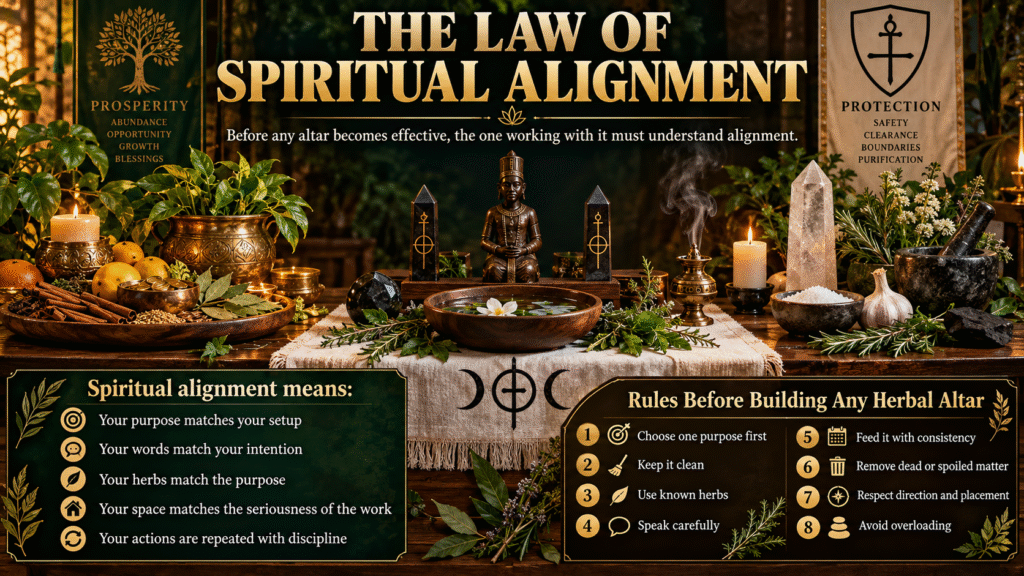
THE LAW OF SPIRITUAL ALIGNMENT
The Hidden Principle Behind Powerful Herbal Altars, Spiritual Authority, Protection, Wealth, And Manifestation
Before You Build an Altar, You Must Understand the Power of Alignment.
There is an important principle that every serious student of African spirituality, herbalism, ancestral practice, and spiritual altar work should understand:
An altar does not become meaningful simply because powerful herbs, sacred objects, expensive oils, or spiritual symbols have been placed upon it. Its deeper purpose comes from the relationship between intention, preparation, arrangement, spoken words, and disciplined action.
You may have a room filled with spiritual materials, yet lack direction in your practice. Another person may have a small wooden table, a bowl of clean water, three carefully chosen herbs, and a clear purpose—and experience greater personal focus, confidence, and consistency.
Why?
Because spiritual practice is not simply about collecting objects. It is about understanding what those objects represent, why they are being used, and how they support the purpose of the person working with them.
This is what I call THE LAW OF SPIRITUAL ALIGNMENT.
In many spiritual traditions, an altar is treated as more than a physical arrangement. It is a dedicated place for prayer, remembrance, reflection, gratitude, offerings, and the expression of spiritual intentions.
Different Ghanaian, Yoruba, Ewe, Vodun, and other African traditions have their own teachings, sacred obligations, and ritual requirements. The principles discussed here form a general framework for personal herbal altar practice rather than a single universal rule belonging to every African spiritual system.
When your purpose, herbs, words, environment, and daily conduct support one another, your altar becomes a consistent centre of spiritual attention and personal discipline.
1. WHAT IS SPIRITUAL ALIGNMENT?
Spiritual alignment is the deliberate agreement between five important elements of spiritual practice:
- Your purpose must match your altar arrangement.
- Your spoken words must agree with your intention.
- Your chosen herbs must correspond with the purpose of the work.
- Your spiritual environment must reflect seriousness, cleanliness, and respect.
- Your physical actions must demonstrate consistency and discipline.
These five principles create what we may call the Five Foundations of Altar Alignment.
Think of an altar as a meeting place between intention and action.
If your intention is peace, but you approach the altar every day with threats, anger, and revenge, your emotional conduct contradicts the peace you are seeking.
If your intention is financial progress, but your altar practice is not accompanied by planning, responsible spending, and productive effort, you are neglecting the practical side of your goal.
If your purpose is protection, yet you continually expose yourself to unsafe situations without establishing boundaries, symbolic protection alone cannot solve the problem.
Your altar should remind you of the life you are trying to build—not become a substitute for the actions required to build it.
This is the deeper meaning of alignment.
2. WHY DIFFERENT ALTARS REQUIRE DIFFERENT ARRANGEMENTS
One common mistake in personal spiritual practice is using the same arrangement for every intention.
Someone wants wealth, protection, love, confidence, healing, and spiritual communication, so they place every available herb, perfume, stone, candle, and symbol on one small table.
Eventually, the altar becomes overcrowded.
There is no central intention, no recognisable arrangement, and no clear working method.
A focused altar should have a purpose that can be understood immediately.
A. The Wealth and Prosperity Altar
A prosperity altar is intended to symbolise opportunity, growth, provision, generosity, successful trade, and responsible financial movement.
Its arrangement should communicate welcome and expansion rather than hostility.
Suitable symbolic materials may include:
- Basil (Ocimum basilicum) — associated in some contemporary spiritual practices with prosperity, welcome, and positive intentions.
- Cinnamon (Cinnamomum verum) — used symbolically for warmth, motivation, sweetness, and movement.
- Prekese (Tetrapleura tetraptera) — a culturally significant West African plant whose pods may be included in personal Ghanaian herbal practices.
- Clean coins — representing financial responsibility and exchange.
- Fresh water — symbolising clarity, renewal, and the sustaining of life.
- Green or gold cloth — optional colours commonly associated with growth and prosperity in modern symbolic arrangements.
These associations are not fixed rules shared by every traditional spiritual community.
Practical direction: Place a clean cloth on a small table. Arrange one dried prekese pod, a few dried basil leaves, one cinnamon stick, a clean bowl of water, and three coins.
Keep the bowl of water separate from the dried herbs.
At the centre, place a written financial goal such as starting a business, developing a skill, increasing savings, or managing debt.
Stand before the arrangement each morning and declare:
“May my hands recognise useful opportunities. May wisdom guide my decisions. May honest work increase my resources, and may I have the discipline to protect what I earn.”
Spend three to five minutes reflecting on one practical financial action you will complete that day.
Refresh the water daily and review your financial goals every seven days.
The spiritual arrangement serves as a focus for intention and discipline; it does not guarantee wealth or cause money to appear supernaturally.
B. The Protection and Peace Altar
A protection altar should communicate firmness, peace, personal boundaries, purification, and emotional steadiness.
It should not be overwhelmed with objects meant to attract attention or influence other people’s decisions.
Possible symbolic materials include:
- Neem leaves (Azadirachta indica) — representing resilience, cleansing, and the protective qualities traditionally associated with this tree.
- Clean water — representing calmness and clarity.
- A smooth natural stone — representing stability and firm boundaries.
- A small dish of salt — symbolising purification in various traditions, although its use and meaning differ.
- White cloth — an optional symbol of peace and simplicity.
Practical direction: Cover a small surface with clean cloth and place a smooth stone in the centre.
Arrange a few identified, clean neem leaves beside the stone, together with a separate bowl of water.
Speak:
“Let peace remain within my home. Let my decisions be guided by wisdom. May I recognise danger, maintain strong boundaries, and walk with courage and a clear mind.”
Sit quietly for five minutes and consider one boundary you need to strengthen.
Repeat the practice for seven days if you wish to establish a personal routine.
Remove wilted leaves, change the water daily, and clean the surface regularly.
This symbolic practice should accompany sensible safety precautions, appropriate medical care, and lawful protection where required.
C. The Authority, Leadership, and Commanding Presence Altar
An altar dedicated to personal authority should represent dignity, uprightness, self-control, courage, discipline, and clear communication.
It does not need twenty different herbs or a crowded collection of spiritual objects.
In this form of practice, simplicity can strengthen focus.
Consider:
- A clean, firm wooden surface.
- One upright stone or carefully selected natural object.
- A single dried bay leaf (Laurus nobilis), symbolising honour or achievement in various traditions.
- A clean writing pen, representing communication and responsible decisions.
- White, brown, or another personally meaningful cloth.
- A written leadership intention.
Practical direction: Place the stone upright at the centre of your table. Position the pen and your written intention neatly in front of it.
Stand comfortably, with good posture.
Declare:
“May I speak with knowledge, act with wisdom, and lead without fear. Let my words carry truth, my decisions carry fairness, and my presence reflect discipline and dignity.”
Practise speaking clearly for three minutes.
If you are preparing for a meeting, interview, public address, or important conversation, rehearse your main points and examine the facts before you speak.
Use the arrangement before important engagements, or daily during a period of leadership development.
True authority is demonstrated through competence, integrity, and consistency—not through controlling or frightening other people.
THE EIGHT RULES BEFORE BUILDING ANY HERBAL ALTAR
RULE ONE: CHOOSE ONE PURPOSE FIRST
A confused intention produces a confused practice.
Before arranging a single leaf, root, stone, bowl, or spiritual item, ask yourself:
“What exactly am I establishing this altar to represent?”
Is it for protection?
Is it for ancestral remembrance?
Is it for business focus?
Is it for spiritual reflection?
Is it for emotional healing and peaceful living?
Your answer must be specific.
Do not try to combine wealth, revenge, attraction, healing, dream work, protection, and confusion into one arrangement without understanding the different intentions involved.
For example, if the purpose is attracting customers to your business, focus your altar on welcome, hospitality, business development, gratitude, and opportunity.
If the purpose is personal protection, focus on peace, boundaries, vigilance, and stability.
If you require several distinct practices, separate them into clearly identified spaces or use one altar for different purposes at different times, cleaning and resetting it between practices.
One altar. One principal purpose. One clear direction.
RULE TWO: KEEP YOUR ALTAR CLEAN
Cleanliness is not merely about appearance.
In personal spiritual practice, cleanliness may represent readiness, order, honour, and respect.
A table covered with rotten plants, mouldy offerings, stagnant water, dust, leaking oils, and broken containers becomes unhygienic.
It can also undermine concentration and peaceful reflection.
Before beginning any altar work:
- Remove unnecessary objects from the surface.
- Wipe the area with clean water and allow it to dry.
- Wash the bowls and containers you intend to use.
- Inspect all herbs for mould, insects, or spoilage.
- Arrange your materials neatly.
- Keep the surrounding floor and working space clean.
You may choose to begin with a moment of silence or words of gratitude.
Do not assume that unpleasant smells, smoke, dirt, or decaying matter automatically indicate greater spiritual strength.
A serious altar should be maintained with the same care that you would give any important place in your home.
RULE THREE: USE KNOWN HERBS WITH A CLEAR PURPOSE
Every plant has its own botanical identity, traditional history, physical characteristics, and possible risks.
Do not place unidentified leaves, roots, barks, seeds, or powders on an altar because someone describes them as spiritually powerful.
Learn the correct scientific name, the plant part being used, and the cultural context of its traditional associations.
For example:
| Plant | Botanical name | Possible symbolic role |
|---|---|---|
| Basil | Ocimum basilicum | Welcome, growth, harmony |
| Neem | Azadirachta indica | Resilience, cleansing, boundaries |
| Prekese | Tetrapleura tetraptera | Heritage, nourishment, provision |
| Rosemary | Salvia rosmarinus | Remembrance, attention, clarity |
| Cinnamon | Cinnamomum verum | Warmth, motivation, abundance |
These are illustrative symbolic meanings, not proven supernatural properties or universal African classifications.
For herbal altars, dried or fresh plant materials may be used as displays without drinking, eating, burning, or rubbing them on the skin.
Avoid poisonous plants, unidentified powders, smoke from unknown materials, and herbal mixtures prepared without adequate safety knowledge.
Know your herb before you use your herb.
RULE FOUR: SPEAK CAREFULLY—YOUR WORDS SHOULD AGREE WITH YOUR PURPOSE
Your spoken words help define the purpose and emotional atmosphere of your practice.
Consider someone standing before an altar meant for peace while repeatedly speaking words of hatred and destruction.
The language contradicts the intention.
Similarly, a person seeking confidence should avoid continually describing themselves as helpless and incapable.
Before speaking at your altar, establish the message you want to reinforce.
For protection, speak of boundaries, safety, peace, and courage.
For prosperity, speak of wisdom, opportunity, honesty, and productive effort.
For leadership, speak of fairness, self-control, clarity, and responsible authority.
For healing, speak of patience, restoration, appropriate care, and hope.
A useful general declaration is:
“Let my thoughts become clearer, my speech become wiser, and my actions remain faithful to the good purpose I have chosen.”
Words do not automatically control external events, but deliberate speech can help reinforce attention, values, and responsible action.
RULE FIVE: MAINTAIN YOUR ALTAR WITH CONSISTENCY
Many people establish an altar enthusiastically, use it for one or two days, and then abandon it.
After several weeks, they return expecting the arrangement to carry the same personal significance without any attention or maintenance.
In spiritual language, consistent care is sometimes described as feeding or renewing an altar.
However, the meaning of feeding differs considerably between traditions. A formally consecrated shrine may have specific requirements determined by its custodians.
For a simple personal herbal altar, consistent attention may include:
- Replacing clean water.
- Offering words of gratitude or prayer.
- Practising a few minutes of quiet breathing.
- Reflecting on personal progress.
- Removing spoiled materials.
- Reorganising the arrangement.
- Reviewing the practical commitments associated with the altar.
Incense or smoke is optional, not a requirement. Where permitted by a tradition, it must be used with ventilation, fire safety, and consideration for people with asthma or other respiratory conditions.
A simple five-minute daily practice can be more sustainable than elaborate ceremonies that cannot be maintained.
Discipline gives continuity to intention.
RULE SIX: REMOVE DEAD, ROTTEN, OR SPOILED MATERIALS
Fresh leaves eventually wilt.
Flowers dry.
Fruits decay.
Water becomes contaminated.
These are natural processes, and no altar arrangement can prevent them indefinitely.
Within symbolic practice, spoiled materials may be interpreted as reminders to remove neglect, clutter, or stagnation.
However, rotting herbs do not scientifically demonstrate that spiritual blockage, curses, or supernatural forces are present.
Inspect your altar regularly.
If an item develops mould, an unpleasant smell, or visible decay, remove it.
Compost uncontaminated plant materials where appropriate, or dispose of them safely in ordinary household waste.
Wash containers thoroughly before reusing them.
Do not leave perishable offerings indoors for prolonged periods or place food where it attracts insects and rodents.
Renewal should be a deliberate practice, not an excuse for allowing decay.
RULE SEVEN: RESPECT DIRECTION, POSITION, COLOUR, AND PLACEMENT
The physical arrangement of an altar can carry powerful symbolic meaning for the person or community using it.
The centre may represent the principal intention.
The corners may be used to organise supporting elements.
Height may represent visibility, honour, or leadership.
The ground may represent stability and connection with the earth.
Cloth colour may distinguish different purposes.
Some traditions also recognise particular directions, positions, or rules for sacred spaces.
But there is an essential warning:
There is no single compass direction, colour system, or object arrangement that is authoritative across all African spiritual traditions.
An Akan family shrine, a Yoruba sacred space, an Ewe ritual setting, and an individual contemporary herbal altar may follow very different conventions.
Do not invent a traditional rule where none has been verified.
For a personal altar without lineage-specific instructions, use simple, meaningful arrangements.
Place the primary symbol at the centre. Keep supporting objects around it. Leave enough open space for cleaning, prayer, writing, or meditation.
Choose colours intentionally rather than treating them as magical guarantees.
And where a shrine belongs to a particular tradition, seek guidance from a recognised practitioner or appropriate custodian before changing its layout.
RULE EIGHT: AVOID OVERLOADING YOUR ALTAR
One of the strongest lessons in altar practice is that more objects do not necessarily mean greater spiritual significance.
A large collection can become distracting.
A small collection can communicate a clear purpose.
You do not need fifty kinds of herbs when three carefully chosen plants are sufficient to express the intention.
You do not need seven perfumes, twelve oils, and multiple candles merely because you want a serious arrangement.
Every item should answer a question:
“Why is this here?”
If you cannot explain an item’s purpose, consider removing it until you have researched its significance.
Think of your altar as a carefully written sentence.
Every object should contribute meaning.
Too many unrelated objects can obscure the message.
Spiritual clarity is not measured by how crowded your table becomes.
HOW TO BUILD A SIMPLE ALIGNED HERBAL ALTAR: STEP BY STEP
The following is a general personal altar practice using safe, accessible materials. It is not presented as a historically authenticated ritual from any single African spiritual lineage.
Materials
- One clean, stable table or wooden board.
- One clean white or natural-coloured cloth.
- One small bowl of drinking-quality water.
- One to three identified, non-toxic herbs appropriate to your intention.
- One clean stone or meaningful natural object.
- One piece of paper.
- One pen.
- Optional: one personally meaningful symbolic object.
Step 1: Define your intention
Write one clear purpose on the paper.
For example:
“I am establishing this space to strengthen wisdom, personal discipline, and progress in my business.”
Avoid vague intentions that combine many unrelated goals.
Step 2: Prepare the space
Clean the table and its surroundings.
Choose somewhere free from unnecessary disturbance, excessive heat, and risk of accidental fire.
A bedroom corner, study, or dedicated shelf may be suitable.
Step 3: Lay your cloth
Spread the cloth neatly.
Treat this as the visible boundary of your personal reflection space.
Step 4: Position your principal object
Place the stone or another meaningful object in the centre.
Let it represent the purpose you have written.
Step 5: Introduce your herbs
Select herbs according to their verified identity and the symbolic meaning you have chosen for them.
Place dry herbs in clean dishes rather than scattering powders freely.
Step 6: Place the water
Set a small bowl of clean water beside the principal object, where it cannot spill onto papers, electrical equipment, or other materials.
Let the water represent clarity and renewal.
Step 7: Speak your intention
Stand or sit comfortably and say:
“With a clear mind and peaceful purpose, I establish this space as a reminder of my intentions. May wisdom guide my words, discipline strengthen my actions, and gratitude remain in my heart. Let my work be directed toward peace, responsible growth, and the good of my life.”
You may replace this declaration with a prayer appropriate to your personal faith or tradition.
Step 8: Sit quietly
Spend five minutes reflecting.
Ask yourself what meaningful action you can undertake to support the intention of the altar.
Write down that action.
Step 9: Maintain the arrangement
For the next seven days, return to the space at a consistent time.
Renew the water daily, inspect the materials, and review your written commitment.
Step 10: Complete or renew the practice
At the end of seven days, evaluate your progress.
Have you followed through on your commitments?
Have your decisions improved?
Do you need a different plan?
You may clean and renew the altar, or close the practice respectfully by expressing gratitude and returning the space to ordinary use.
The seven-day period is a suggested routine for consistency, not a universally required sacred duration.
FIVE SIGNS THAT YOUR ALTAR PRACTICE IS BECOMING MORE ALIGNED
You do not need to search for frightening signs or supernatural manifestations to assess your practice.
Look for practical and observable changes:
1. Your intention becomes clearer. You can explain the purpose of the altar without confusion.
2. Your environment becomes more orderly. The space remains clean, maintained, and free from unnecessary clutter.
3. Your words become more deliberate. You begin expressing your goals with greater clarity and self-control.
4. Your daily actions become more consistent. You develop habits that support your intentions.
5. Your judgment becomes more disciplined. You are less likely to make decisions based solely on fear, pressure, or desperation.
These are meaningful indicators of personal progress. They should not be confused with scientific proof of supernatural activity.
SEVEN MISTAKES THAT CAN WEAKEN YOUR SPIRITUAL PRACTICE
Avoid these common errors:
- Changing your purpose every day. A constantly shifting intention makes consistency difficult.
- Using unknown herbs. Misidentified plants can expose you to unnecessary health risks.
- Copying sacred practices without understanding them. Traditional ritual systems should be approached with cultural respect.
- Allowing dirt and spoilage to accumulate. Neglect creates hygiene problems and distracts from the purpose of the space.
- Seeking power without responsibility. Personal authority should never become an excuse for coercion, threats, or cruelty.
- Expecting objects to replace effort. An altar cannot substitute for work, honest communication, professional treatment, or sensible decisions.
- Measuring success only through extraordinary signs. Consistency, clarity, and constructive change deserve attention too.
THE DEEPER SECRET: YOU MUST LIVE IN AGREEMENT WITH YOUR ALTAR
Consider this carefully.
If you establish a wealth altar, practise financial discipline.
If you establish a protection altar, establish healthy boundaries.
If you establish an authority altar, develop knowledge, confidence, and integrity.
If you establish a healing altar, respect your body’s needs and seek appropriate healthcare.
If you establish an ancestral remembrance altar, preserve family history, honour the living, and approach inherited traditions with respect.
An altar should not become a place where a person repeatedly requests change while refusing to participate in that change.
Its deeper value can lie in helping you remember your commitments and return to them.
The herbs, stones, water, cloth, and spoken words may represent your intention.
But your behaviour demonstrates whether you are prepared to live by that intention.
This is why spiritual alignment is not simply something you arrange on a table.
It is something you practise in your everyday life.
FINAL TEACHING: THE ALTAR MUST HAVE A PURPOSE, AND THE PRACTITIONER MUST HAVE DISCIPLINE
Before you build your next herbal altar, remember these words:
Do not gather herbs without knowledge.
Do not arrange symbols without purpose.
Do not speak powerful words while neglecting responsible action.
Do not confuse a crowded altar with a meaningful altar.
Do not seek spiritual authority while abandoning personal discipline.
A carefully prepared altar can become a place of reflection, cultural connection, remembrance, gratitude, and intentional living.
Its spiritual meaning depends on the beliefs and traditions of those who use it, and no particular supernatural outcome can be guaranteed.
The most useful principle remains simple:
Align your purpose. Align your words. Align your herbs. Align your environment. Align your actions.
When these five foundations work together, your altar becomes more than an arrangement of objects. It becomes a deliberate expression of the values, responsibilities, and direction you have chosen for your life.
THIS IS THE LAW OF SPIRITUAL ALIGNMENT.
May wisdom guide the hands that gather the herbs, clarity guide the mind that arranges them, and responsibility guide the life of the person who works with them.
About Nufutene Herbal And Spiritual
At Nufutene Herbal And Spiritual, we explore African herbal knowledge, traditional spiritual philosophy, natural symbolism, responsible spiritual wellness, and practical education on the respectful use of nature’s resources.
We aim to preserve valuable knowledge while encouraging careful plant identification, cultural understanding, personal responsibility, and safe practice.
Law of Spiritual Alignment, African Herbal Altar, How to Build a Spiritual Altar, Herbal Altar Preparation, Spiritual Altar Rules, Spiritual Alignment and Manifestation, African Spirituality, Wealth Altar, Protection Altar, Authority Altar, Spiritual Herbalism, Altar Cleansing, Herbal Spiritual Practices, Spiritual Discipline, Nufutene Herbal and Spiritual.
#TheLawOfSpiritualAlignment #SpiritualAlignment #AfricanSpirituality #HerbalAltar #SpiritualHerbalism #AfricanHerbalWisdom #SpiritualAuthority #ProtectionAltar #WealthAltar #SpiritualDiscipline #AncestralWisdom #HerbalKnowledge #NufuteneHerbal #KingdomOfHerbs
Share this teaching with anyone who wants to understand the importance of purpose, discipline, and responsible preparation before establishing a personal spiritual altar.